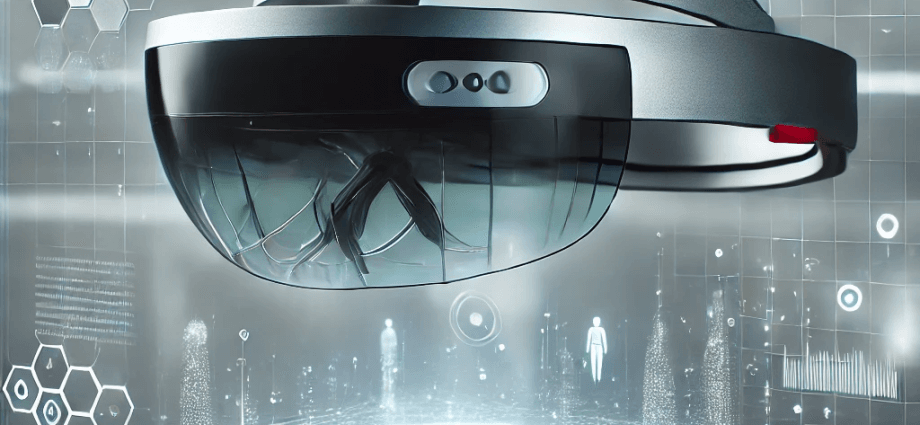
HoloLens is a revolutionary augmented reality (AR) device developed by Microsoft. It allows users to see and interact with 3D holograms that are blended into the real world. The technology has garnered attention for its ability to combine virtual elements with physical surroundings, making it an exciting tool for industries like healthcare, education, and design. This article will explore the features, applications, and challenges of HoloLens, as well as its potential for the future.
What is HoloLens?
HoloLens as a Mixed-Reality Device
HoloLens is not just an AR device; it’s a mixed-reality (MR) headset that merges real and virtual worlds. Unlike traditional AR, which overlays digital content on the physical environment, HoloLens creates interactive 3D holograms that appear to occupy the real world. This allows users to engage with virtual objects as if they were physically present. It’s like stepping into a digital world while still being aware of and interacting with the physical world around you.
HoloLens offers an experience where the boundaries between physical reality and digital elements blur, allowing users to manipulate digital objects in real time, enhancing how we interact with technology.
How HoloLens Works
At its core, HoloLens relies on several sophisticated technologies to create its immersive experience. It uses sensors, cameras, and powerful processing chips to scan and map the environment. This mapping allows holograms to interact with the physical space around them, creating the illusion that they’re real objects.
Some of the key components in HoloLens include:
- Depth sensors that measure the environment’s dimensions
- Cameras that capture the user’s surroundings
- Microphones for voice input
- Advanced processors that run the complex software powering the system
Together, these elements make it possible for the device to display holograms that seem to exist in real space.
Key Features of HoloLens

Holographic Displays and Spatial Mapping
One of the standout features of HoloLens is its ability to project 3D holograms into the user’s environment. Using a technique known as spatial mapping, HoloLens scans the user’s surroundings and determines where holograms can be placed. This allows users to see digital objects in their room or workspace, which can be interacted with in real time.
Key benefits of spatial mapping:
- Real-time interaction: Users can move around holograms and manipulate them from any angle.
- Contextual placement: Holograms can be positioned in the user’s environment based on walls, floors, or other objects.
- Enhanced immersion: The blending of digital objects with the real world creates a sense of depth and realism.
Eye Tracking and Hand Gestures
HoloLens also features eye-tracking technology that allows it to detect where the user is looking. This feature improves interaction by enabling the device to respond to eye movements, making the experience more intuitive. For example, if a user looks at a hologram, the system can focus on it or offer additional options based on where the user is directing their attention.
Along with eye-tracking, HoloLens supports hand gestures. This means users can control digital objects simply by moving their hands in specific ways, like pinching to zoom or swiping to scroll. This combination of eye tracking and hand gestures makes using HoloLens feel natural and fluid.
Voice Commands
HoloLens can also be controlled through voice commands. Users can say phrases like “Hey, HoloLens” to activate the device and issue commands like opening apps, adjusting settings, or controlling holograms. Voice recognition is a hands-free way to interact with the device, making it ideal for situations where users are unable to use their hands or want to focus on a task without distractions.
Applications of HoloLens in Various Industries
Healthcare
In healthcare, HoloLens is used for medical training, surgery, and patient care. Surgeons, for example, can overlay patient data or 3D models of organs onto the patient’s body during surgery. This allows for better planning and more precise procedures. HoloLens is also used in medical education, where students can interact with 3D anatomy models, providing a more engaging learning experience.
Some of the benefits for healthcare include:
- Surgical planning: Surgeons can visualize procedures before performing them.
- Medical training: Trainees can interact with holographic representations of body systems.
- Remote collaboration: Doctors and specialists can use HoloLens for virtual consultations, sharing data and 3D models in real time.
Education and Training
In education, HoloLens helps create immersive learning environments. Students can explore historical landmarks, practice chemistry experiments, or interact with 3D models of biological organisms. The immersive nature of HoloLens makes learning more engaging and can improve understanding, especially for complex subjects.
Key uses in education:
- Immersive experiences: Virtual field trips and interactive simulations.
- Skills development: Hands-on training for professions like engineering and surgery.
- Collaborative learning: Students can work together on virtual projects, even from different locations.
Architecture and Design
HoloLens is transforming architecture and design by enabling real-time visualization of projects. Designers can walk around a holographic version of a building or interior space, allowing them to identify potential issues before construction begins. This not only saves time but also improves collaboration between designers and clients.
How HoloLens is used in design:
- 3D modeling: Architects can view and modify models in real-time.
- Client presentations: Clients can experience a virtual walkthrough of designs.
- Collaboration: Multiple users can interact with the same holographic design at once.
Challenges and Limitations
Battery Life and Comfort
Despite its impressive features, HoloLens faces challenges with battery life and comfort. The device can only run for a few hours on a single charge, limiting its use for long periods. Additionally, wearing the headset for extended sessions can become uncomfortable, especially for people who wear glasses or need to adjust the fit regularly.
Some issues with comfort:
- Heaviness: The headset can feel heavy after extended use.
- Strain on the eyes: Prolonged use may cause discomfort for some users.
- Limited battery: The device needs frequent recharging for long sessions.
Cost and Accessibility
HoloLens is priced high, making it less accessible for smaller businesses, educational institutions, and individuals. While the technology is groundbreaking, the cost of entry can be a barrier for many potential users. As the technology advances, however, prices may decrease, making it more accessible to a wider audience.
Challenges in accessibility:
- High cost: The initial price tag may be prohibitive.
- Limited availability: HoloLens may not be available in all regions.
- Learning curve: New users may require time to understand how to use the device effectively.
The Future of HoloLens and AR
Advancements in AR Technology
The future of HoloLens looks promising, with continued advancements in hardware and software. Future models could offer improved battery life, better comfort, and enhanced processing power. We can also expect more realistic and interactive holograms as AR technology continues to evolve.
Impact on Everyday Life
As AR devices like HoloLens become more advanced, they could significantly impact everyday life. Tasks such as shopping, navigation, and work could be transformed by seamless integration of digital elements into the real world. Remote work, for example, could become more immersive with virtual meetings and shared spaces.
Conclusion
HoloLens is a groundbreaking AR device that offers innovative solutions across various industries. From healthcare to education and design, it is changing how we interact with the world around us. While challenges remain, particularly in terms of cost and comfort, the future of AR looks promising. As technology advances, devices like HoloLens may become a regular part of our daily lives, revolutionizing how we work, learn, and communicate.